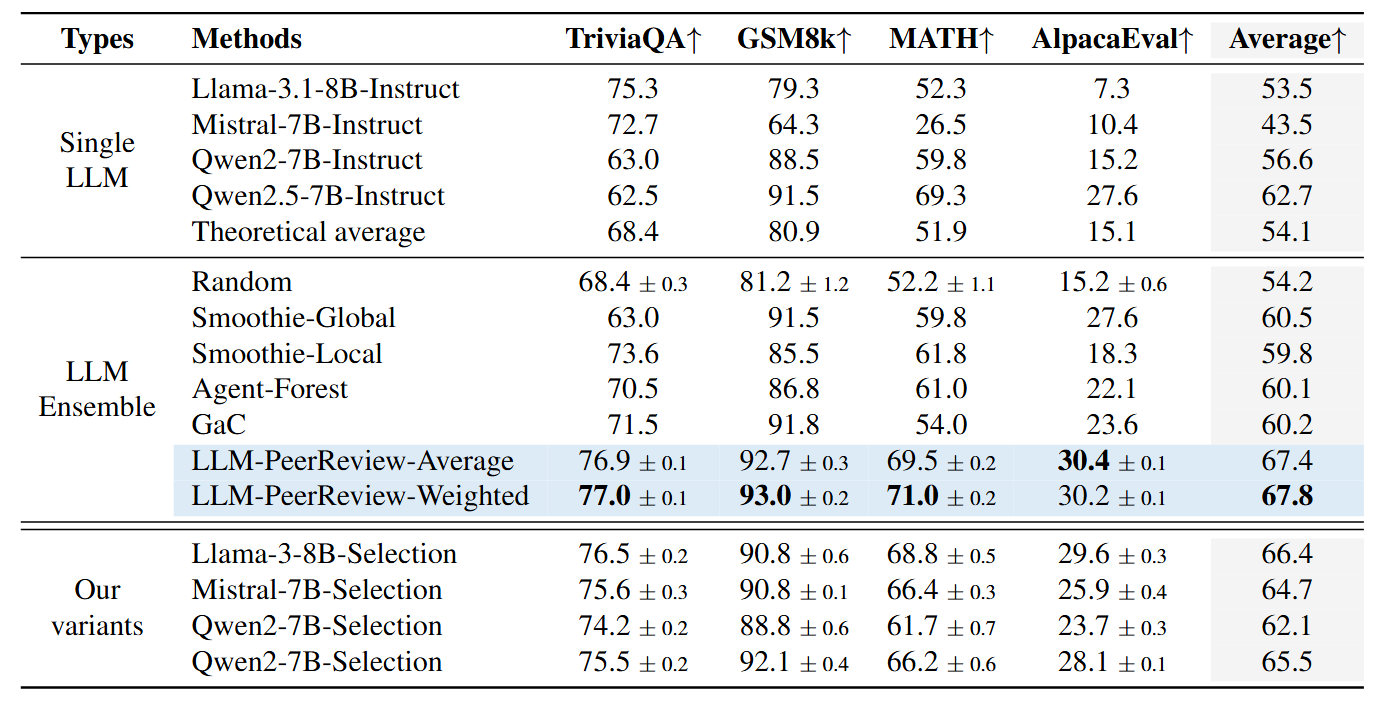
The main results are shown in the table. First, by examining the results in the “Single LLM” and “LLM
Ensemble” sections of the table, one key finding is that both LLM-PeerReview and LLM-PeerReview-W
consistently outperform any single LLM and all LLM Ensemble baselines across all datasets. In the last
column, which presents the average performance, our two variant methods (with results of 67.4% and
67.8%) surpass the strongest single model, Qwen2.5, by 4.7% and 5.1%, respectively, and outperform the
advanced ensemble method, Smoothie-Global, by 6.9% and 7.3%. These results directly demonstrate the
effectiveness of our method, as it achieves superior performance by integrating the collective
knowledge of multiple models across factual-recall QA tasks, math reasoning tasks, and
instruction-following tasks. Also, the ensemble task across these four datasets is challenging, as the
performance of the four LLMs varies significantly for each dataset.
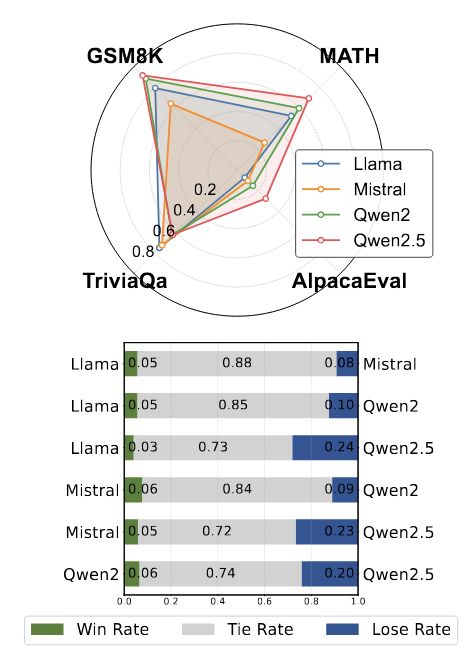
In the figure, the upper subplot presents a radar chart of individual LLM performance, while the lower
subplot displays the win-tie-loss chart for models on the challenging instruction-following dataset,
AlpacaEval. This figure highlights that models with the best overall performance may underperform on
specific tasks compared to those with weaker overall results. In summary, the results in the table and
figure demonstrate that a strong LLM does not excel across all datasets. Each model has its strengths
and weaknesses, highlighting the substantial practical significance of LLM Ensemble.
In the “Our variants” of the table, we present the performance of using a single LLM as a judge to
select the optimal response. From the average performances in the last column of the table, we observe
that these variants perform quite well (surpassing the overall best model, Qwen2.5, in 3/4 cases). On
the other hand, when comparing the performance of these variants with that of our prototype
LLM-PeerReview, it becomes clear that aggregating and averaging the scores from multiple judges is
beneficial.
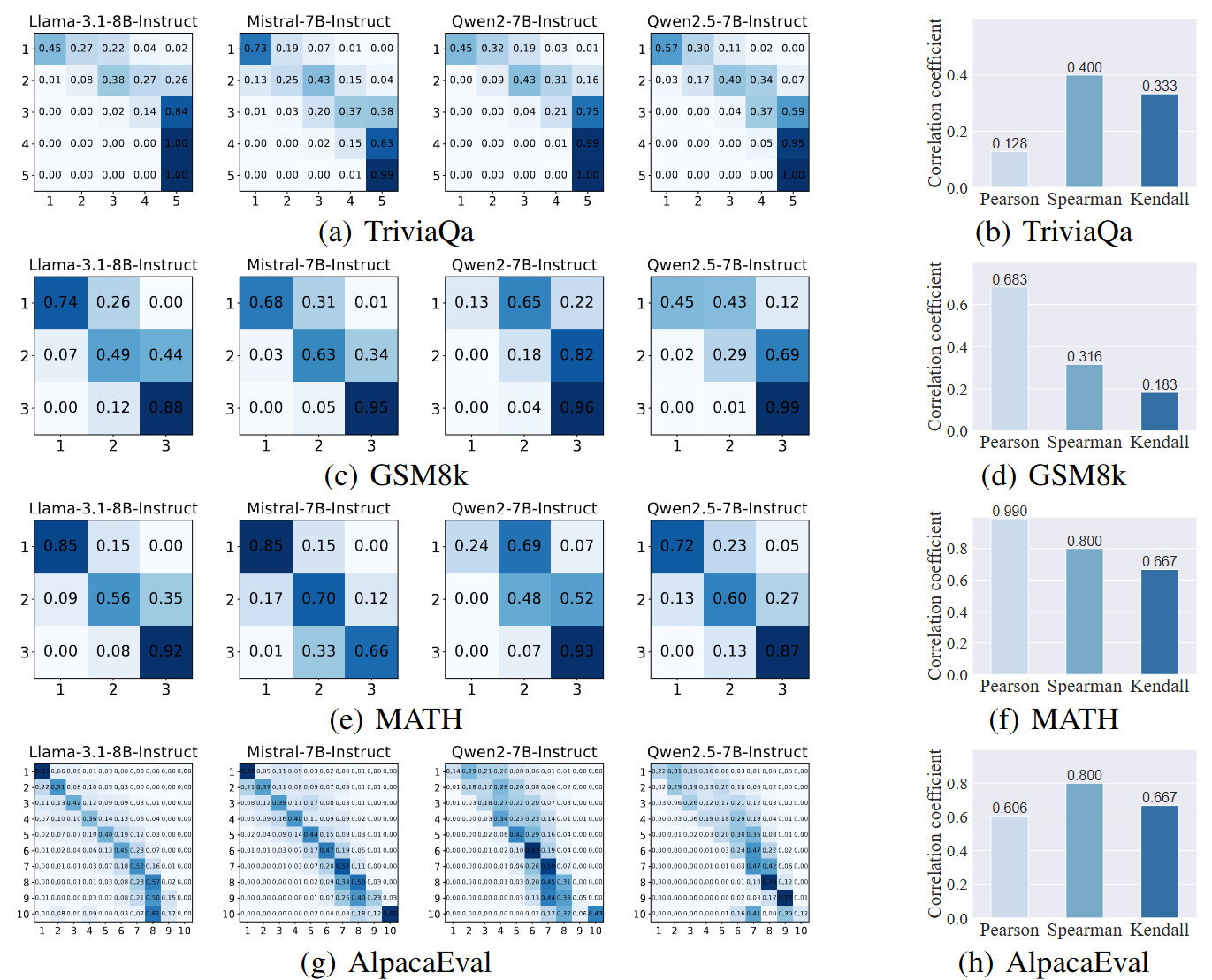
By observing the average results in the table, we find that LLM-PeerReview-W leads to further
performance gains compared to LLM-PeerReview. In the left subplot of the figure, we observe subtle
variations in the transition matrices learned for each model. On the other hand, the right subplot in
the figure, displaying positive correlation coefficients, demonstrates that our method can effectively
identify stronger and weaker judges.
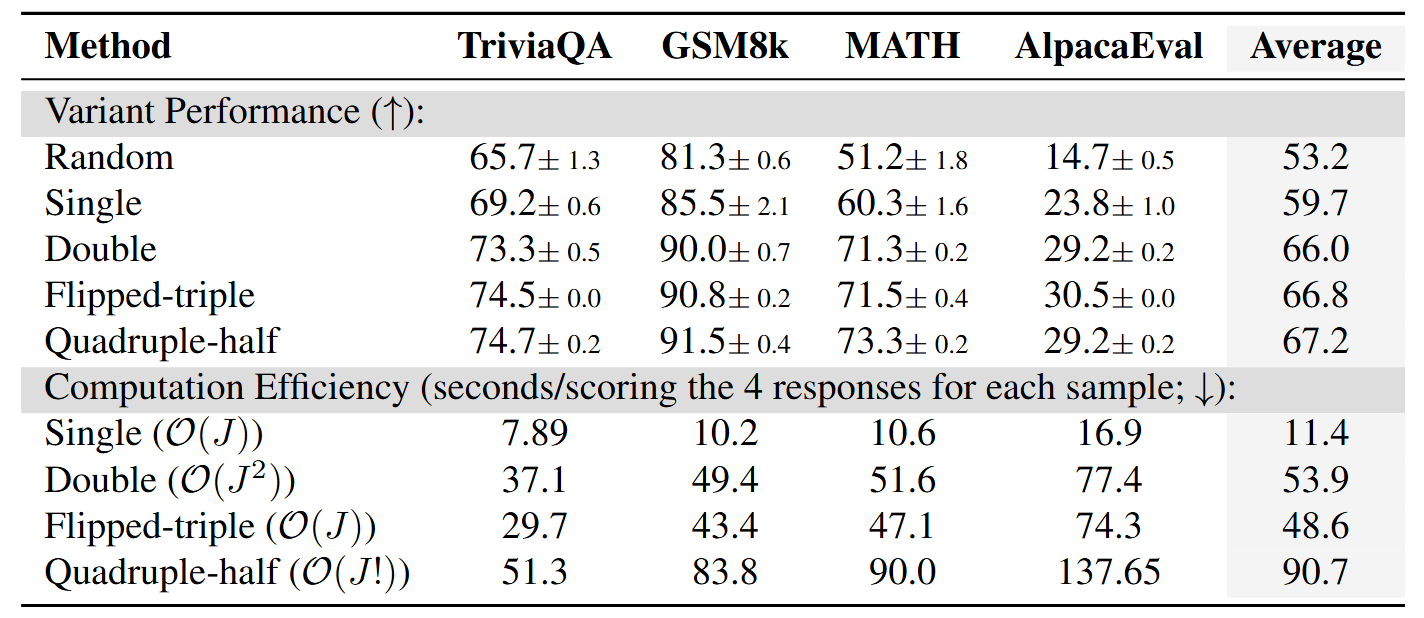
(1) It is intuitive that, in addition to our recommended flipped-triple scoring method, several
variant scoring methods could be employed. (Their definitions are provided in the caption of the
table.) Overall, the performance of these four variants follows the order:
quadruple-half > flipped-triple > double > single. Variants
quadruple-half, flipped-triple, and double all offer noticeable de-biasing performance advantages
over the single-scoring strategy. On the other hand, in terms of theoretical computational complexity,
the complexities of single/double/flipped-triple/quadruple-half are
O(J)/O(J2)/O(J)/O(J!), respectively, with flipped-triple having the lowest computational
complexity among the de-biased strategies.
Further, in the table, we present the scoring efficiency of these four strategies. Compared to
strategies double and quadruple-half, strategy flipped-triple is the most time-efficient. (2)
Furthermore, the remarkable performance gain—from 59.7 with the original single to 66.8 with the
proposed flipped triple—validates the profound debiasing impact of our scoring technique. This
technique serves as a crucial cornerstone of LLM-PeerReview.
The table compares their post-generation inference costs, excluding the shared response-generation
stage. On GSM8K and MATH, LLM-PeerReview requires substantially less GPU time. This advantage mainly
comes from its simpler interaction pattern: our scoring stage requires only one round, in which each
judge outputs a few scalar scores, whereas MAD performs two debate rounds and requires every model to
generate much longer revised full responses in each round. Also, as shown in the table, our final
selecting step incurs virtually no additional computational cost.
As discussed in Section 2.4, our framework allows for flexibility in reducing the judge count during
deployment to further enhance efficiency, building upon the efficient flipped-triple scoring strategy.
The Appendix also shows that LLM-PeerReview remains effective in a lightweight setting: using fewer
judges during scoring still outperforms the baselines.
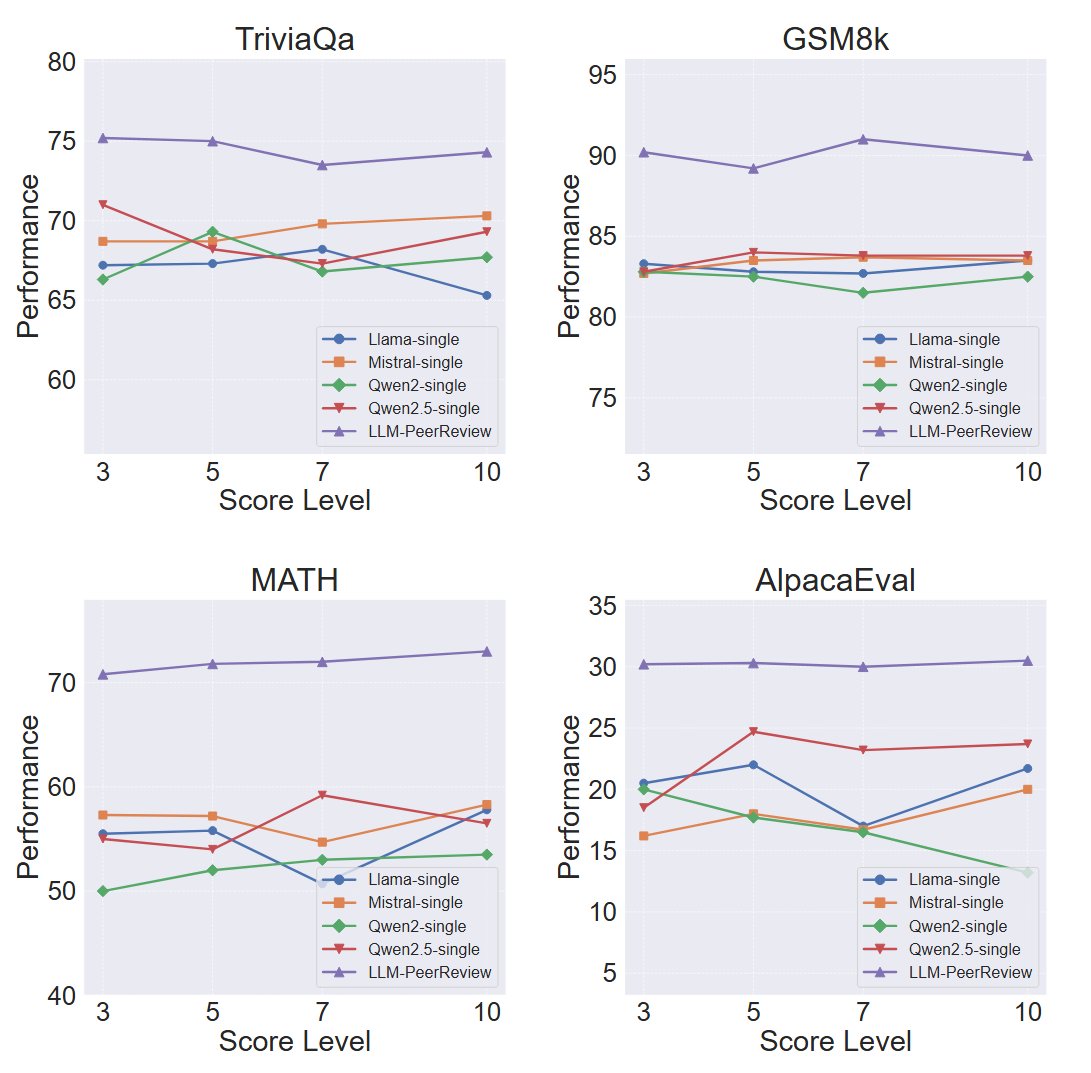
In the figure, we conduct a further analysis of how different scoring levels influence the performance
of flipped-triple judges. For each scoring level, we have carefully crafted meaningful descriptions and
corresponding prompts. Under these conditions, these judges exhibit varying performance, showing no
consistent tendencies across the levels of 3, 5, 7, and 10. In addition, as indicated by the prompts in
the Appendix, for the main experiment in the table, the scoring levels for the four datasets were 5, 3,
3, and 10, respectively.
We provide more comprehensive experimental analyses in the Appendix, including performance results of
LLM-PeerReview variants using the “Single” scoring strategy, win-tie-loss charts across all models on
four datasets, full analysis for the transition matrix, additional results using varying numbers of
judges, the performance of LLM-PeerReview with 13B-scale LLMs, more efficiency/cost analysis for
LLM-PeerReview and four case studies across the four datasets respectively.